Counseling for drug and alcohol.com

My name is Beverly Barnes Rayfield and I’ve worked with people with chronic and severe problems for the last twenty-something years. But, I’ve lived with chronic and severe and very nice people for the last 60 years so I guess that gives me additional qualifications to teach what I’ve learned. (I’m also a licensed alcohol and drug counselor and have held, or hold, other specialty licenses/certificates/permits/degrees—an advantage when one is a generalist in life.)


Because I’ve worked with thousands of people over the years, and because I’m a natural-born Southern storyteller, I’ve learned what makes some people click immediately with a treatment program—and why some people struggle and never make their way to sobriety.


I don’t lecture. I like to give examples of people who put all their worth into making a blessing out of what started out good and then, after a disaster in life based on wrong decisions or a wrong turn, left them scrambling to get out of a self-inflicted hole.


What I have found out is actually pretty simple—it comes down to altitude and attitude.


I just yesterday watched (for probably the fifteenth time) “Apollo 13” with (drum roll) Tom Hanks and a slew of really good actors … Ed Bradley, Kevin Bacon … you’ve seen it.


Recall: The movie tells the story of an attempted moon landing gone wrong. It is a story of the determination and team work between the astronauts in space and the ground teams in Houston and Cape Kennedy. It is a story of what it took to bring three men (more drum roll: Jim Lovell, Jack Sweigert, and Fred Haise) back to their families. The first “space rescue”. The odds of them making it, and living to tell the story, was something like one in ten million.


If you talk to someone who has an obsessive-compulsive addiction to opiates or alcohol or methamphetamines or cocaine they will tell you they feel like they have the same odds for recovery—1 in 10 million. They have been lost in their own inner space with no guidance.


In the movie, near the ending, as the three astronauts are moments away from a safe landing, or burning up on re-entry to the Earth’s atmosphere, as everyone is waiting and listening to static noise, this conversations tensely takes place at Mission Control:


Mission Planner: “This is going to be NASA’s greatest disaster.”


And actor Ed Bradley (Mission Control Supervisor) replies, “With all due respect Sir, this is going to be NASA’s finest hour.”


And, it was, It was because determination and teamwork brought three men who never lost hope, and work together to make it through a time of sheet terror to get home safely. It was an attitude of “I will make it happen. Failure is not an option”.


As YOU, my friend, work through what has been a time of your personal challenge, and perhaps potential disaster, please know that, with all due respect, you have the opportunity to make this time your finest hour. You can live to tell the story—or, if you want, to just recall that it was a blip on the radar screen of your life.


I ask that you spend fifteen minutes a day just recalling, remembering that others have had challenges that seemed insurmountable—and succeeded. Have a Safe Journey and return home safely.


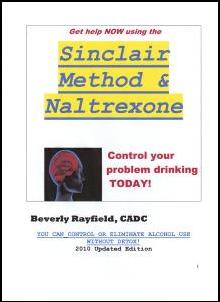
Get Help NOW Using the Sinclair Method & Naltrexone provides the treatment protocol used in the Sinclair Method and has been developed as an information resource to allow you and your family greater participation and control in your treatment of excessive alcohol use, abuse, or dependency.

Available now for only $29.95

Download the best e-book written about alcohol abuse treatment

For more information

The Cure for Opiate and Pain Medication Addiction

This treatment protocol and workbook has been developed as an information resource to allow you and your family greater participation and control in your treatment of opiate dependency

Download now —Just $40.00

What to do if your doctor will not prescribe Naltrexone

I have written a letter for your physician which details exactly what the treatment protocols are, what medications are used, and what strength, dosage, and what the expected outcome should be.

Download now— $10.00

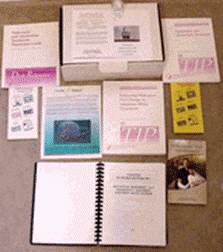
Our comprehensive program:   $300.00 (free shipping within the US)

For those who can not attend our program in Sarasota, Florida, we have put together all the information, references and protocols we use in our program, plus the Cure of Alcoholism Workbook and Letter to your doctor, so you may use your own family doctor and therapist. To Order now click here

The Cure for Alcoholism Workbook

The companion book for “The Cure for Alcoholism”.

Complete medication management and treatment protocol that allows you to work with your physician in your hometown to reduce or eliminate your alcohol use.

Order Now! Just $45.00 plus shipping 

THE GOOD NEWS: Research clearly shows drug abuse is a preventable behavior—and drug addiction is a treatable brain disease.


Over the past forty years (the same amount of time that we’ve sent men into outer space and brought them back), the United States “War on Drugs” has produced leading medical research that shows the “how and the why” of drug addiction. One of the world’s leading supporters of research specifically regarding drug abuse, the National Institute of Drug Abuse (NIDA established in 1974 has helped families better understand the complex biomedical, behavioral, and social aspects of drug abuse. NIDA says:


Drug abuse is not a problem of people who have character flaws and weak wills.


Researchers have indentified specific sites in the brain where every major drug of abuse (opiates, cocaine, PCP and marijuana (THC) has its initial effect. These discoveries have paved the way for the development of such medications as buprenorphine (Subutex and Suboxone) and naltrexone for the treatment of opiate addiction.


Researchers have also shown the value of concurrently treating drub abusers’ depression, anxiety and other mental disorders to improve the positive outcome and reduce relapse.


Researchers are working on the development of new, targeted medications and vaccination that will block individual aspects of drugs such as eliminating craving, euphoria and other results of drug addiction.


Buprenorphine is a cornerstone of opiate treatment. It is a “new” drug that has actually been in use world-wide for the last fifteen years. It is new to the United States (approved in 2004) and new to most opiate-dependant people. It is a life-saver for many.


Thank you to David Sinclair PhD, a researcher in Finland who brought it to my attention in 1999.


Good luck in your new life, safe journey.


- Beverly Rayfield


Redefining and Rethinking addiction


For hundreds—if not thousands—of years, talk regarding addiction revolved around the dramatic physical withdrawal symptoms which occur when the addicted person stops taking the drug. That drug might be opiates in its various forms, alcohol, nicotine, cocaine, or methamphetamine.


The belief was that the more dramatic the physical withdrawal symptoms (such as those with morphine or heroin or alcohol) the more serious or dangerous the drug must be. This belief is wrong—cocaine and methamphetamine are both very addictive, but produces minimal physical withdrawal symptoms. Psychological addiction, however, is huge and dramatic. The brain has been taught to enjoy and to crave.


Drug addiction is a brain disease. Although initial drug use might be voluntary, drugs of abuse have been shown to alter gene expression and brain circuitry, which in turn affect human behavior. Once addiction develops, these brain changes interfere with an individual’s ability to make voluntary decisions, leading to compulsive drug craving, seeking and use.


The core of addiction is the psychologically uncontrollable, compulsive drug seeking and use of drugs. Drug craving and other obsessive compulsive behaviors (such as lying, stealing from family, friends and employers) are extremely difficult to control, much more difficult than detoxing from physical dependence.


For the addicted BRAIN, nothing beneficial (home, job, family, kids, security, love) seems to outweigh drug craving as the motivator to continue using. Even the physical pain of experiencing another detox will not stop the addicted brain from craving and ultimately relapsing to use.


The impact of addiction can be far reaching. Cardiovascular disease, stroke, cancer, HIV/AIDS, hepatitis, and lung disease can all be affected by drug abuse. Some of these effects occur when drugs are used at high doses or after prolonged use, however, some may occur after just one use.


In today’s world, the real focus of treatment is not “just” to manage “simple” withdrawal symptoms, but to stop the relapse pattern and gain control over drug craving, drug seeking and drug use.


During the first few weeks of treatment, the focus for the patient is to immediately stop the detox withdrawal symptoms, elevate anxiety/depression, and resume a normal work/life pattern. The focus of the patient’s family is typically to prevent relapse.


Rethinking the “addiction pattern” also involves rethinking which drugs (medicines) are addictive, and which drugs (medicines) can be used for longer term maintenance to allow a higher quality of life. We also need to look at if, when or which drugs (medicines) can produce a new dependence, and new pattern of uncontrollable drug seeking and use.


Uncontrollable cravings can be treated utilizing a clinical toolbox which includes behavioral counseling, peer review, and a new class of medication, buprenorphine, as well as older medicines, naltrexone or methadone.